How Does a Privacy Screen Filter Work? The Technology Behind Limited Viewing Angles
In today's digital workplace, protecting sensitive information involves more than securing files and networks. Information displayed on a laptop or monitor can also be exposed when someone nearby views the screen from the side. A privacy screen filter helps reduce this risk by limiting the angles from which on-screen content can be clearly seen.
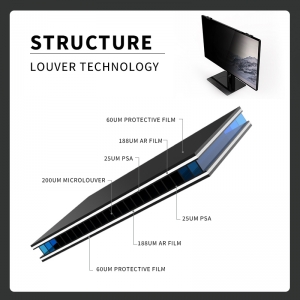
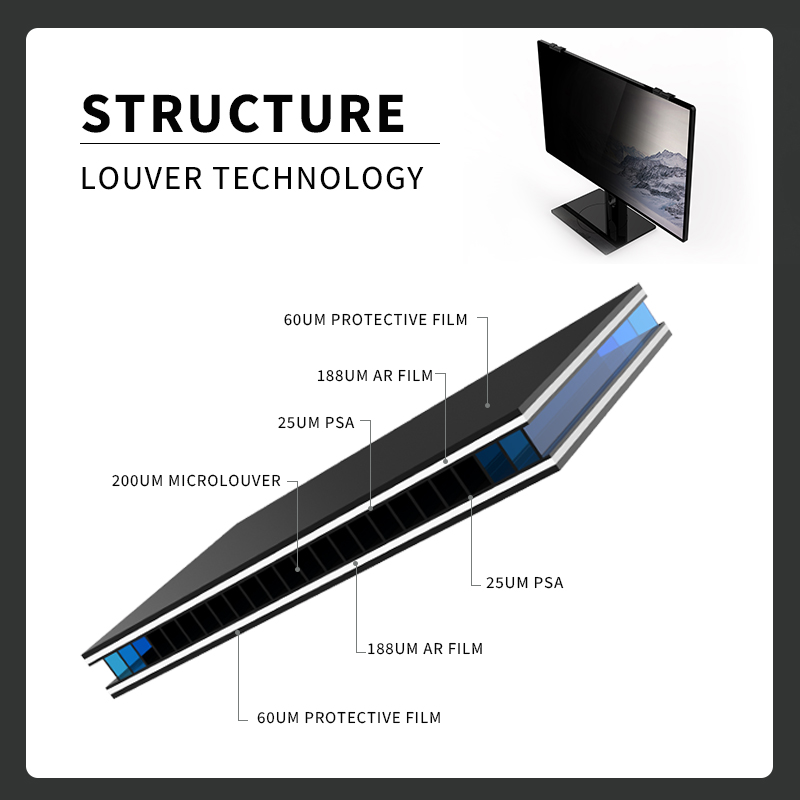
A privacy screen filter works by controlling the direction of light leaving the display. Many traditional privacy filters use a micro-louver structure containing tiny vertical light-blocking elements. These elements allow light to pass toward the intended viewer while blocking much of the light traveling toward people positioned to the left or right. As a result, the screen remains more visible from the front and becomes darker or less readable from side angles.
Understanding this technology helps businesses, IT teams, distributors, and procurement professionals evaluate privacy filters for different devices and working environments.
1. What Is a Privacy Screen Filter?
A privacy screen filter is an optical accessory designed to reduce the visibility of screen content from unwanted viewing angles. It is commonly used with laptops and desktop monitors in offices, public spaces, shared work environments, and other locations where screen privacy matters.
Unlike a conventional clear screen protector, which primarily protects the display surface, a privacy filter is designed to control viewing direction. Depending on its construction, it may also provide additional functions, such as reducing reflections or helping protect the screen surface.
Privacy filters are especially relevant for people who work with confidential documents, customer information, financial records, business communications, or other sensitive on-screen data.
However, a privacy filter is not a substitute for device security, access controls, or safe information-handling practices. Its main purpose is to reduce the risk of visual exposure from nearby observers.
2. How Does Privacy Filter Technology Work?
The key principle behind many privacy filters is directional light control.
A display produces light that travels outward toward the viewer. Without a privacy filter, the screen can generally be viewed from a relatively wide range of angles, although brightness, contrast, and color appearance may change with the viewing position.
A privacy filter modifies how much light can pass toward different viewing directions.
The micro-louver structure
Many conventional privacy filters use a structure known as a micro-louver layer. This layer contains numerous tiny, closely spaced light-blocking elements that act somewhat like miniature vertical blinds.
The principle can be explained in three steps:
-
Front viewing: Light traveling toward the intended viewer can pass through the openings in the micro-louver structure, allowing the screen content to remain visible.
-
Side viewing: Light traveling at more oblique angles encounters the light-blocking elements, reducing the amount of display light reaching a viewer positioned to the side.
-
Reduced visibility: Because less light reaches the side observer, the screen appears darker and its content becomes more difficult to read.
The result is a narrower practical viewing area compared with an unfiltered display.
The exact optical design varies between products. The degree of privacy depends on factors such as the filter structure, display characteristics, installation, and the angle at which the screen is viewed.
3. What Happens When You View a Screen from Different Angles?
Privacy filters are designed to create a difference between the intended viewing direction and off-axis viewing directions.
When a user sits in front of the screen, the display content can remain visible through the filter. As another person moves toward the left or right, the filter blocks more of the light traveling in that direction. At sufficiently oblique angles, the screen may appear very dark, making the displayed information harder to distinguish.
The transition is not necessarily an instant change from completely visible to completely black. Visibility generally changes with viewing angle, ambient lighting, screen brightness, and the design of the specific filter.
This distinction is important for buyers: a stated viewing angle should be interpreted according to the manufacturer's definition and test conditions, rather than assumed to mean that all content becomes completely invisible immediately outside that angle.
What does a 2-way privacy filter mean?
A 2-way privacy filter typically restricts viewing from the left and right sides while preserving a more direct front viewing position.
This design is often considered for laptop and monitor applications in which side-by-side observers are the main concern.
The term “2-way” does not automatically mean that the screen is protected equally from every direction. Buyers should confirm whether the product is designed for horizontal privacy, vertical privacy, or another specific viewing arrangement.
4. What Factors Affect a Privacy Filter's Viewing Angle?
Not all privacy filters deliver the same viewing experience. Several factors influence how effectively a filter limits off-axis visibility.
Optical structure
The design and geometry of the light-control layer influence the directions in which light can pass through the filter. Different optical structures can produce different balances between front visibility and side privacy.
Display brightness
The brightness of the underlying display affects the viewing experience. A brighter screen may remain more noticeable from some off-axis positions, depending on the filter design and surrounding lighting.
Screen and filter compatibility
A filter must be compatible with the display's dimensions and intended installation method. Incorrect positioning or an unsuitable fit can affect usability and may compromise the intended privacy effect.
Ambient lighting
Bright surroundings, reflections, and the observer's position can influence perceived privacy. For this reason, privacy performance should be evaluated under realistic working conditions rather than relying on a single viewing angle alone.
Viewing position
The distance between the observer and the screen, the height of the screen, and the direction from which the screen is viewed all affect how much information remains visible.
For business buyers, the most useful approach is to evaluate the privacy filter on the actual type of device and in an environment similar to the intended application.
5. Privacy Filter vs. Standard Screen Protector: What's the Difference?
Although privacy filters and standard screen protectors may look similar, their primary functions are different.
| Feature |
Privacy screen filter |
Standard clear screen protector |
| Primary purpose |
Reduce visibility from unwanted viewing angles |
Help protect the display surface |
| Light control |
Designed to restrict off-axis light transmission |
Generally designed to preserve broad viewing visibility |
| Side-angle visibility |
Reduced according to the optical design |
Usually remains broadly visible from the side |
| Typical applications |
Offices, travel, shared workspaces, and privacy-sensitive environments |
Everyday screen-surface protection |
| Key buying consideration |
Viewing-angle performance and display compatibility |
Surface protection, clarity, and compatibility |
Some products may combine multiple functions, but buyers should check the actual specifications rather than assume that every screen protector provides privacy protection.
6. Why Do Businesses Use Privacy Screen Filters?
For organizations, visual privacy is a practical part of managing information exposure.
Common applications include:
-
Corporate offices: Help reduce the visibility of work displayed on monitors in open-plan environments.
-
Business travel: Help protect laptop screens from casual side viewing in airports, hotels, and other shared spaces.
-
Financial and administrative teams: Add a layer of visual privacy when handling sensitive records and business documents.
-
Customer service areas: Reduce the chance that nearby visitors can easily view information on employee screens.
-
Shared workstations: Support privacy in environments where people work close to one another.
A privacy filter cannot guarantee that information will never be seen by an unauthorized person. Its effectiveness depends on the product, setup, user behavior, and working environment. Organizations should treat it as one layer of a broader information-protection approach.
7. How Should Buyers Evaluate Privacy Filter Technology?
For distributors, importers, corporate IT teams, and private-label brands, selecting a privacy filter requires more than comparing product appearance or screen size.
Consider the following factors before purchasing:
1. Viewing-angle performance
Ask the supplier to explain how the viewing angle is defined and how the product performs from the front and sides. If viewing-angle figures are provided, check the test conditions and measurement method.
2. Optical clarity
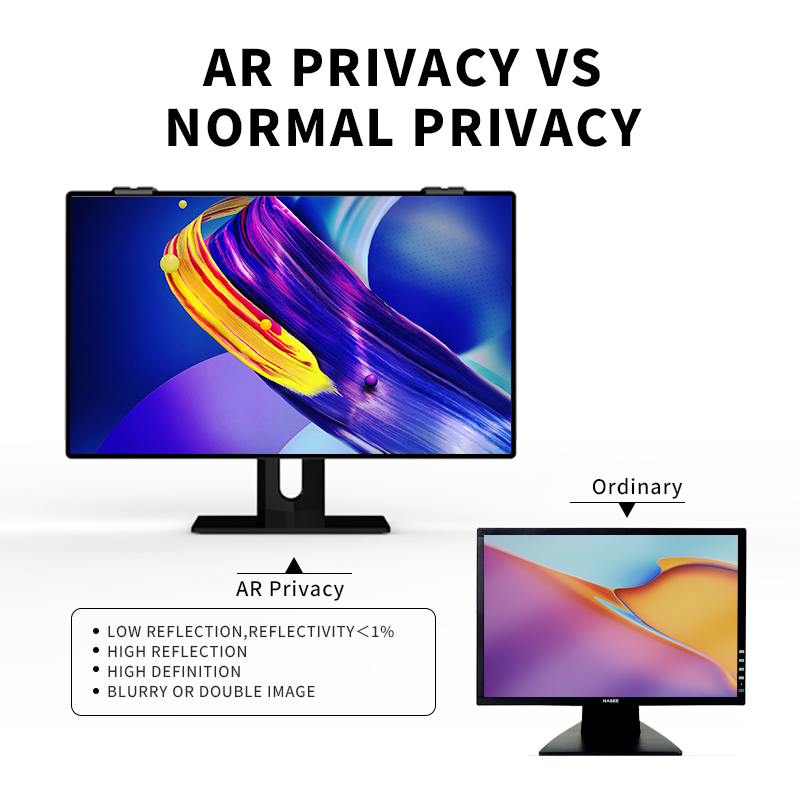
Evaluate whether the screen remains comfortable to use for the intended tasks. Front-view clarity, brightness, and the appearance of fine text may vary by product and display.
3. Device compatibility
Confirm the screen dimensions, aspect ratio, bezel design, and intended installation method. Laptop and desktop monitor filters may require different compatibility checks.
4. Installation and removal
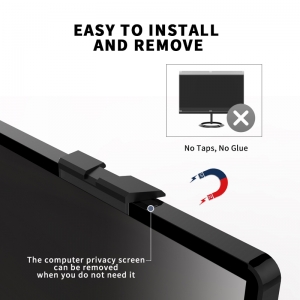
Determine whether the mounting method suits the device and the user's daily workflow. The available attachment options depend on the specific product design.
5. Sample evaluation
Where possible, test a sample on the target device. Compare front-view readability and side-view privacy under realistic lighting conditions before confirming a bulk order.
6. Manufacturing and customization requirements
B2B buyers should also discuss required dimensions, product configurations, branding, packaging, quality checks, and order quantities with the manufacturer.
A clear specification and sample approval process can help reduce compatibility issues and misunderstandings before mass production.
FAQ
How does a privacy screen filter make a screen look dark from the side?
Many privacy filters use a micro-louver structure that blocks light traveling at certain angles. A person viewing the screen from the side receives less display light, so the content appears darker and is harder to read.
Do all privacy screen filters use micro-louver technology?
No. Micro-louver structures are common in conventional privacy filters, but optical designs can vary. Buyers should check the technology and performance claims of the specific product.
Does a privacy filter block all side viewing?
Not necessarily. Privacy filters reduce off-axis visibility, but the degree of privacy depends on the optical design, viewing angle, screen brightness, ambient lighting, and installation. They should not be treated as a guarantee that content is completely invisible from every side position.
Does a privacy filter reduce screen brightness?
A privacy filter can reduce the amount of light reaching the viewer because it controls light transmission. The perceived effect depends on the filter design, the display, and the viewing conditions. Buyers should evaluate front-view brightness and clarity when selecting a product.
Are laptop and monitor privacy filters based on the same principle?
Many use the same general principle of limiting off-axis light transmission. However, laptop and monitor filters may differ in dimensions, compatibility requirements, and mounting design.
How can a business verify a privacy filter's performance?
Request product specifications and, where available, documented test information. Evaluate samples on the intended display and compare front-view usability with side-view visibility under realistic conditions. Avoid relying on a viewing-angle number without understanding how it was measured.
Conclusion
A privacy screen filter works by controlling the direction of light leaving a display, reducing how much screen light reaches observers positioned outside the intended viewing area. Many conventional designs achieve this through a micro-louver structure that allows more direct light to pass while blocking more oblique light.
For businesses sourcing laptop and monitor privacy filters, understanding this optical principle makes it easier to evaluate viewing-angle claims, front-view clarity, device compatibility, and real-world performance.
YIPI (Shenzhen Xinpai Electronics Co., Ltd.) focuses on laptop and monitor privacy filter products for business applications. If you are sourcing privacy filters for distribution, corporate procurement, or a private-label product range, contact our team to discuss your device requirements and product specifications.
Website: https://www.privacyfilter.com/